
Disclosure: Gamingshopee is reader-supported. If you buy through links on this page, we may earn a commission at no extra cost to you.
If you’ve felt like every gaming peripheral you look at costs noticeably more than it did a couple of years ago, that’s not just inflation anxiety talking. We pulled together publicly reported pricing data across RAM, SSDs, GPUs, and general PC accessories from 2022 through late 2026 to see exactly how much things have moved, and the numbers are more dramatic than most gamers realize.
The short version: 2022 through 2024 saw relatively normal, gradual price movement, with GPU prices actually falling after the cryptocurrency mining crash cooled demand. 2025 into 2026 broke that pattern entirely. AI data center demand for memory chips has driven the sharpest component price spike the PC and gaming hardware industry has seen in years, and it’s rippling into products that have nothing to do with AI at all.
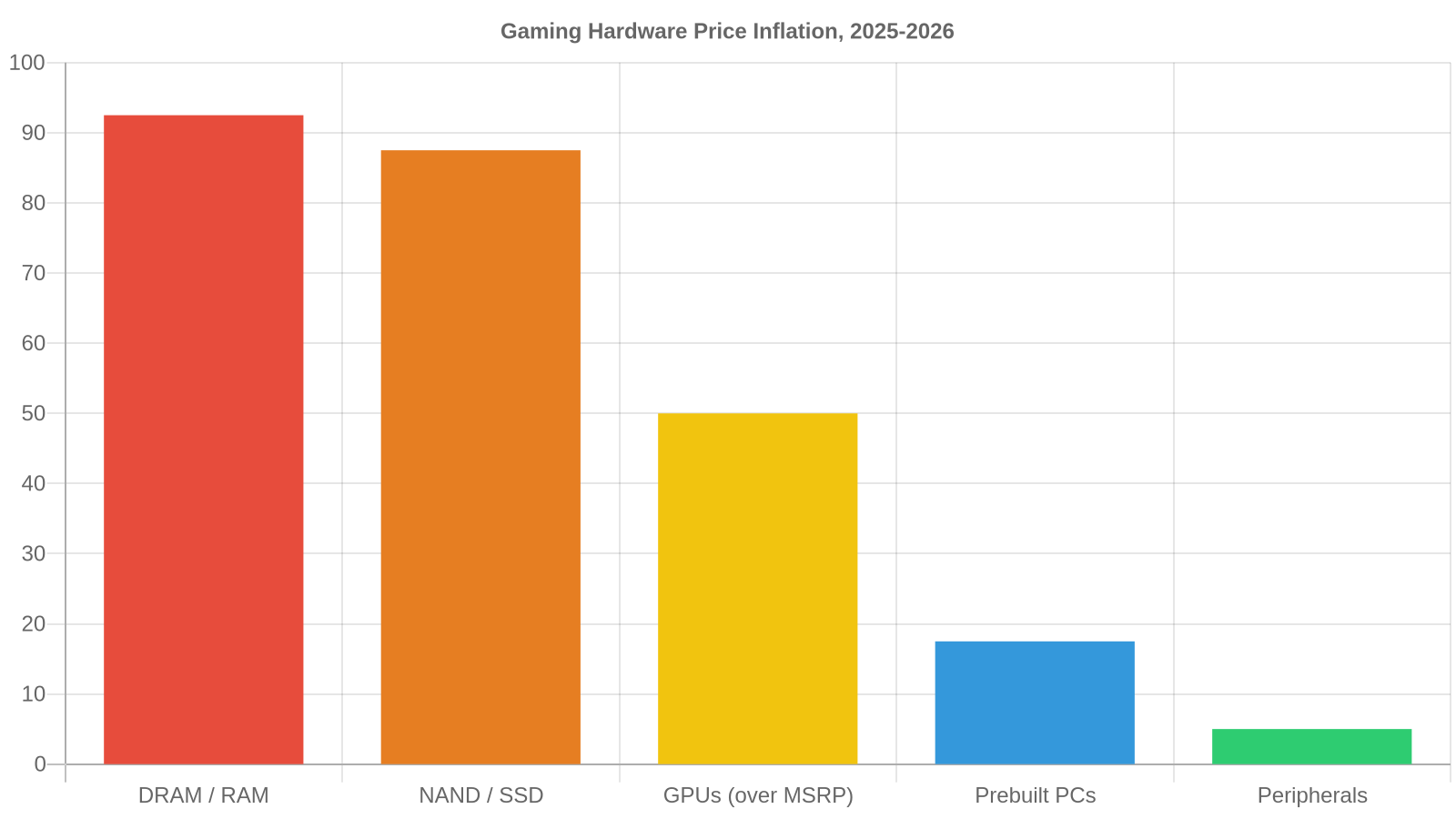
Peripheral & Component Price Inflation (2022-2026) — Quick Reference
| Category | 2022-2024 Trend | 2025-2026 Trend | Primary Driver |
|---|---|---|---|
| DRAM / RAM | Gradual, mostly flat | +90-95% QoQ (Q1 2026) | AI data center HBM demand |
| NAND / SSD storage | Gradual decline | +85-90% QoQ (Q1 2026), 4x+ over 3 quarters | Enterprise SSD orders absorbing supply |
| GPUs | Falling post-crypto-crash | Flagship cards ~50% over launch MSRP | Memory now 80%+ of GPU bill of materials |
| Prebuilt / general PCs | Roughly stable | +15-20% projected for 2026 | Pass-through of DRAM/NAND cost increases |
| Peripherals (mice, keyboards, headsets) | Stable, occasional sales | Modest but real upward pressure | Indirect: shipping, tariffs, general component cost |
How We Compiled This Data
- We pulled from industry pricing trackers and reporting: including Tom’s Hardware’s RAM price index, TrendForce quarter-over-quarter DRAM and NAND contract price data, and manufacturer statements from Phison, Samsung, and major PC brands.
- We cross-referenced multiple sources per category: no single price data point here comes from just one outlet, we looked for agreement across at least two independent reports before including a figure.
- We separated direct and indirect price pressure: RAM and SSDs are directly hit by the chip shortage, while peripherals like mice and keyboards are only indirectly affected through shipping costs, tariffs, and general component inflation.
- We focused on consumer-relevant numbers: enterprise and data center pricing moved even more dramatically than consumer pricing in some categories, but we prioritized figures that reflect what an actual buyer sees at checkout.
RAM: The Epicenter of the 2026 Price Spike
RAM is where this story starts, and it’s the single most dramatic number in this entire study. A conventional 32GB (2x16GB) DDR5 memory kit sold for roughly $100-200 in October 2025. By 2026, the same kit starts at around $350, when it’s even in stock. TrendForce reported DRAM contract prices rising an estimated 90-95% quarter-over-quarter in Q1 2026 alone, followed by a projected 58-63% additional QoQ increase in Q2 2026.
The root cause is AI infrastructure. High-bandwidth memory used in AI data center hardware consumed 23% of global DRAM wafer output in 2026, up from just 8% in 2024. That’s capacity that used to make consumer RAM sticks and is now making memory for AI training clusters instead. Intel has publicly signaled that this shortage won’t meaningfully ease until 2028, well past the “it’ll settle down by next year” hope many buyers had going into 2026.
SSDs and Storage: Following RAM’s Trajectory
NAND flash, the chip technology behind SSDs, has moved almost identically to DRAM and for the same underlying reason. NAND flash contract prices rose 33-38% in Q4 2025, then 85-90% in Q1 2026, compounding to roughly a 4.2-4.5x increase over three quarters. The consumer impact is stark: the Samsung 990 Pro 2TB hit a low of $189 in 2025 but was listed at $478 in April 2026, a 153% increase on a single, specific, trackable SKU.
Even memory cards used in cameras and portable devices have been swept up in this, with 128GB SD cards reportedly approaching $50-60 by mid-2026, up from $25-30 in early 2025. Phison’s CEO has confirmed that all 2026 NAND production is already sold out, with the company describing 2027 as facing a continued “pricing apocalypse” rather than relief.
GPUs: A Sharp Reversal From the 2022-2024 Trend
Graphics cards tell an especially interesting story because the direction of travel completely reversed. After the 2022 cryptocurrency mining crash reduced demand and improved availability, GPU prices spent 2023 and into 2024 gradually normalizing, in some cases falling below launch MSRP as competition between AMD and Nvidia’s lineups intensified.
2026 broke that pattern entirely. Since memory chips now account for more than 80% of a modern GPU’s bill of materials, the same DRAM and NAND shortage driving RAM and SSD prices has hit graphics cards just as hard. Flagship cards are now selling for roughly 50% over their original launch MSRP, with the RTX 5090 reportedly reaching around $4,329 in some markets. IDC analysts forecast AI data centers could consume as much as 70% of global memory output in 2026, up from roughly 20-30% back in 2022, which explains why this shortage hit gaming hardware so much harder than previous supply disruptions.
Peripherals: Smaller Moves, But Real Ones
Mice, keyboards, headsets, and mousepads don’t rely directly on DRAM or NAND the way RAM sticks, SSDs, and GPUs do, so they’ve been spared the most extreme percentage increases in this study. But “spared the worst” doesn’t mean “unaffected.” Manufacturers of PC and gaming accessories have reported rising costs tied to general component inflation, shipping, and tariffs on Chinese-manufactured goods, with reported PC and accessory price increases in the 8-20% range for 2026 depending on category and region.
The practical effect for peripheral buyers is less dramatic than what RAM or GPU shoppers are experiencing, but it’s still worth planning around. A mouse or keyboard that might have cost $60 in 2023 landing closer to $65-70 in 2026 isn’t newsworthy on its own, but it compounds with everything else in a full setup, and it means “wait for it to get cheaper” is a much weaker strategy in 2026 than it was in prior years.
How This Compares to Past Shortages
Anyone who bought a GPU during 2020-2021 will recognize the general shape of this shortage even if the cause is different. That earlier shortage was driven by a combination of cryptocurrency mining demand and pandemic-era supply chain disruption, and it resolved once mining profitability collapsed and manufacturing capacity caught up, roughly an 18-24 month cycle from peak scarcity to normal availability. The 2026 memory shortage is structurally different because the demand driver, AI data center buildout, shows no sign of slowing down the way crypto mining eventually did.
That distinction matters for how you should plan. The 2020-2021 shortage was ultimately a temporary demand spike against relatively fixed supply. The 2026 shortage looks more like a permanent reallocation of manufacturing capacity toward a more profitable customer, data centers can pay far more per chip than consumer PC builders can, and manufacturers have little incentive to prioritize the lower-margin consumer market once AI buyers are willing to pay premium prices for the same production lines.
Tariffs and Shipping: The Other Half of the Peripheral Story
While RAM, SSDs, and GPUs are dealing primarily with a genuine supply shortage, the more modest price increases hitting mice, keyboards, and headsets trace back to a different set of pressures. Tariffs on Chinese-manufactured electronics, where the overwhelming majority of gaming peripherals are produced, have pushed costs up for importers since being expanded in 2025, and those costs get passed through to retail pricing with a lag of a few months as existing inventory sells through first.
Shipping costs have also climbed as a secondary effect of broader supply chain strain, even though peripherals themselves aren’t competing with AI data centers for raw materials the way memory chips are. The net result is that a keyboard or mouse brand doesn’t need a chip shortage to justify a price increase, general cost-of-doing-business inflation across shipping, tariffs, and materials is enough on its own to nudge prices up a modest amount year over year.
What This Means If You’re Buying Right Now
The core takeaway from this data is that waiting for prices to drop is, for the RAM, SSD, and GPU categories specifically, currently the wrong bet. Every credible industry source we found points toward continued pressure through the rest of 2026, with meaningful relief not expected before 2027 at the earliest and full normalization possibly not until 2028. If you need RAM, storage, or a GPU right now for a build or upgrade, prices are more likely to be higher three months from now than lower.
Peripherals are a different calculation. Because the price pressure there is milder and driven more by general inflation than a hard supply shortage, watching for seasonal sales, particularly around Black Friday, still makes sense for mice, keyboards, headsets, and similar accessories, even as the component side of a PC build has stopped following normal seasonal discount patterns.
Common Mistakes When Reading Hardware Price Trends
- Assuming every category moves together: RAM, SSDs, and GPUs are moving in near lockstep due to shared memory chip dependency, but peripherals are on a much gentler curve, don’t apply “everything doubled” thinking to a $60 mousepad.
- Waiting for a price drop on memory-dependent components: every current industry forecast points to continued increases through 2026 and into 2027, waiting is a bet against the prevailing trend right now.
- Ignoring quarter-over-quarter data in favor of year-over-year averages: the RAM and SSD spikes happened so fast that year-over-year figures understate how sharp the recent trend actually is.
- Treating enterprise pricing as consumer pricing: data center and enterprise memory contracts have moved even more dramatically than consumer retail prices in some reports, don’t assume the sticker price you see matches every headline number.
- Overlooking secondary effects: even products that don’t contain much RAM or NAND, like basic accessories, are seeing indirect cost pressure from shipping and tariffs, it’s not just the obvious categories worth tracking.
Prices and specs correct as of October 2026.
Frequently Asked Questions
Why did RAM prices increase so much in 2026?
AI data centers are consuming a massive and growing share of global DRAM production for high-bandwidth memory, leaving far less capacity for consumer RAM manufacturing and driving contract prices up 90%+ quarter-over-quarter in early 2026.
Will gaming peripheral prices come back down?
Peripherals like mice and keyboards have seen milder increases than RAM, SSDs, or GPUs, and since their price pressure comes from general inflation rather than a hard chip shortage, they’re more likely to see normal seasonal sales relief than components are.
When will RAM and SSD prices normalize?
Industry analysts and Intel itself have pointed toward 2028 for full normalization, with only modest relief possibly arriving in 2027 as new memory fabrication capacity comes online.
Are GPU prices increasing for the same reason as RAM?
Yes, memory chips now make up more than 80% of a modern GPU’s bill of materials, so the same DRAM and NAND shortage driving RAM and SSD prices is pushing graphics card prices up as well.
Should I buy RAM or an SSD now instead of waiting?
Based on current industry forecasts pointing toward continued increases through the rest of 2026, buying sooner rather than later is generally the better bet if you have a near-term need, though this isn’t personalized financial advice for your specific situation.
How much have SSD prices actually increased?
Specific tracked models like the Samsung 990 Pro 2TB rose from a 2025 low of $189 to $478 in April 2026, roughly a 153% increase, reflecting NAND flash contract prices multiplying over 4x across three quarters.
Does this price inflation affect console gaming too?
Indirectly, yes, console storage expansion accessories and any console-adjacent hardware relying on NAND flash face the same underlying cost pressure, though console manufacturers have more ability to absorb costs than smaller PC accessory brands.
Is this shortage similar to the 2020-2021 GPU shortage?
It’s different in cause, the 2020-2021 shortage was driven by cryptocurrency mining demand and pandemic supply chain disruption, while the 2026 shortage is driven by AI data center memory demand, but the practical effect on consumer prices and availability feels similar.
Curious how this shortage is shaping specific buying decisions? See our buy a gaming PC now or wait breakdown, or check our Corsair Vengeance RGB DDR5-6000 review for how this affects RAM buying specifically.