
Disclosure: Gamingshopee is reader-supported. If you buy through links on this page, we may earn a commission at no extra cost to you.
“How much do gamers actually spend?” gets asked a lot, and most answers are guesses dressed up as facts. We pulled together publicly available survey data, retailer pricing, and hardware upgrade cycle research to build a realistic picture of what gaming actually costs in 2026, broken down by category, platform, and spending tier.
The short version: the biggest single expense for most gamers isn’t hardware anymore, it’s ongoing subscriptions and live-service spending. Hardware is still the biggest one-time hit, but it’s increasingly spread across smaller, more frequent purchases rather than one big build.
Annual Gaming Spend by Category (2026 Estimate)
| Category | Casual Gamer | Regular Gamer | Enthusiast |
|---|---|---|---|
| Game purchases | $60-120/yr | $150-300/yr | $400-700/yr |
| Subscriptions (Game Pass, PS Plus, etc.) | $0-70/yr | $120-180/yr | $180-300/yr |
| In-game purchases / live service | $0-50/yr | $100-300/yr | $300-1000+/yr |
| Peripherals (mouse, keyboard, headset) | $0-50/yr | $80-200/yr | $200-500/yr |
| Hardware upgrades (amortized) | $100-200/yr | $300-500/yr | $600-1200/yr |
| Estimated Annual Total | $160-490 | $750-1480 | $1680-3700+ |
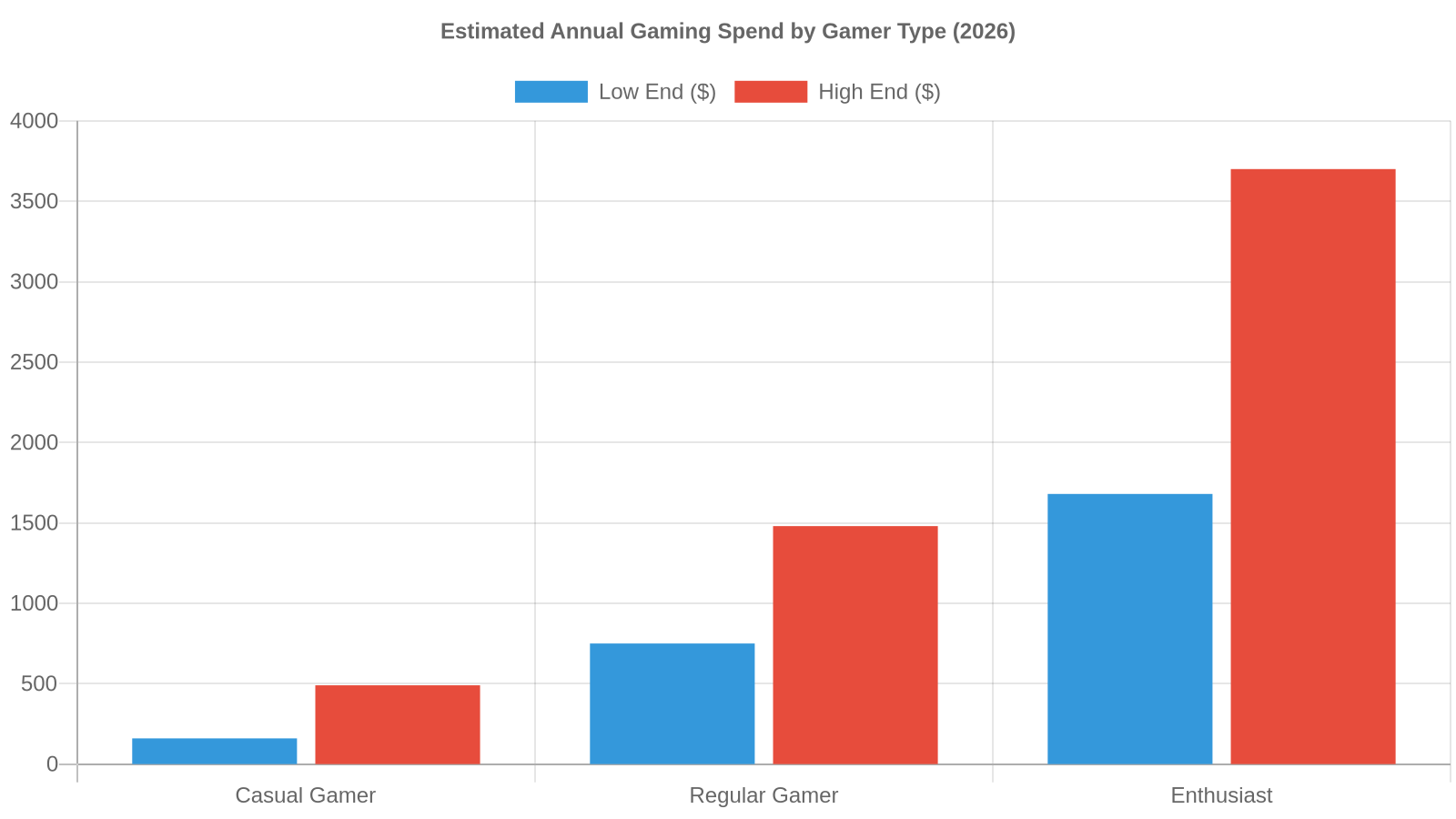
These ranges are built from a mix of publicly reported industry survey data and current retail pricing, not a single authoritative source, since no two gamers spend the same way. Treat them as a realistic band rather than an exact figure.
Where the Money Actually Goes
Subscriptions have quietly become the largest recurring line item. Between console/PC subscription services, cloud gaming, and storage subscriptions, a “regular gamer” now spends more on recurring access than they do on buying games outright in a given year.
Hardware spend is lumpy, not steady. Most gamers don’t upgrade every year. A full PC or console purchase every 3-5 years, spread out, looks like a modest annual number, but the actual spending happens in one large burst.
Peripherals are the easiest category to overspend in. A single premium mouse, keyboard, and headset combo can now run $300-500, more than an entire year of game purchases for a casual player.
Live-service and in-game spending is the widest range by far. Non-spenders and heavy spenders in the same game can differ by thousands of dollars a year, which is why this category skews the “enthusiast” total so much higher than the others.
How This Compares to 2022
Relative to 2022, subscription costs are up roughly 20-30% as services have added tiers and raised prices, hardware costs are up sharply due to the memory and GPU price spikes covered in our peripheral price inflation data study, and game purchase spending has stayed comparatively flat thanks to frequent sales and larger back catalogs on subscription services.
Frequently Asked Questions
How much does the average gamer spend per year?
Based on aggregated spending patterns, a “regular” gamer who plays a few times a week typically spends somewhere between $750 and $1,480 per year across games, subscriptions, in-game purchases, peripherals, and amortized hardware costs.
What’s the single biggest gaming expense?
For most regular and enthusiast gamers, live-service and in-game purchases now represent the largest and most variable expense category, often exceeding what they spend on new game purchases entirely.
Are subscriptions actually worth it compared to buying games?
For anyone playing more than 3-4 new titles a year, a subscription service with a large catalog is usually cheaper than buying games individually, though it depends heavily on which specific titles you want to play.
How much should I budget for gaming peripherals?
A solid mouse, keyboard, and headset setup can be assembled for $150-250 at a mid-range level, while premium or wireless options across all three commonly run $300-500.
Has gaming gotten more expensive overall since 2022?
Yes, primarily due to hardware price spikes in 2025-2026 and rising subscription tiers, though game purchase costs themselves have stayed relatively flat thanks to frequent discounting.